AARDVARK

No
Aardvarks were harmed in
the preparation of this Website
Chronology of Rock ‘n Roll
1931 -1965
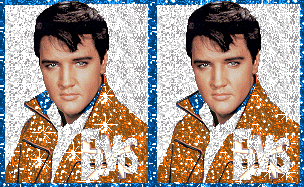
It is reported that several
definitive Theosophical texts were
included
in a personal library that Elvis took on tour.
To the British public, Rock ‘n Roll began
in 1954 with the release of Rock Around the Clock by Bill Haley and His Comets.
The term Rock ‘n Roll and the musical style
had been around in the
Rock ‘n Roll had been a popular term, for
decades, in Black American Culture to refer to dancing or sex and had been used
in many songs.
Prior to the late 1940s the term used to
denote music by black American artists for black audiences was Race Music. The
record industry introduced the less emotive term Rhythm ‘n Blues as a marketing
ploy to sell black music to white audiences.
The term Rhythm ‘n Blues has run side by
side with Rock ‘n Roll since that time.
In 1951 Disc Jockey Alan Free used to term
Rock ‘n Roll to refer specifically to music when he started his radio show “Moondog Rock 'n Roll Party” which played black music for a
white teenage audience.
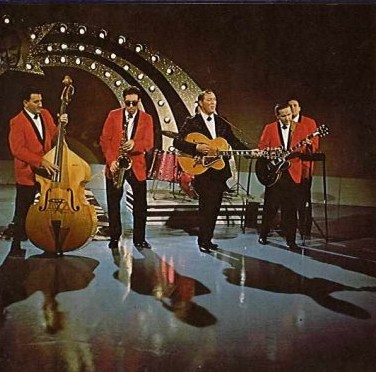
Bill Haley and His Comets
The term Rock ‘n Roll became mainstream
with Bill Haley and His Comets in 1954 but the style he adopted was very close
to that of Louis Jordan who had been playing in that style for a over a decade.
Bill Haley’s popularity burnt out after a couple of years, although he had
several revivals up to 1974, and Rock ‘n Roll was carried forward by Elvis Presley,
Little Richard and others.
Chronology
1931
Adolph Rickenbacker invents the electric guitar.
1936
Billboard
puts out its first record sales chart in 1936.
1938
Bluesman Robert
Johnson records his first record.
Pete Johnson
and Joe Turner cut their first boogie records in
Boom of
boogie woogie in
Telefunken helps develop magnetic tape for use with tape
recorders.
John
Hammond's 'Spirituals to Swing' concert in NYC
Saxophonist
Louis Jordan leaves Chick Webb's sax section to form his Tympany
Five. This might well mark the beginnings of what we know as Rock and Roll.
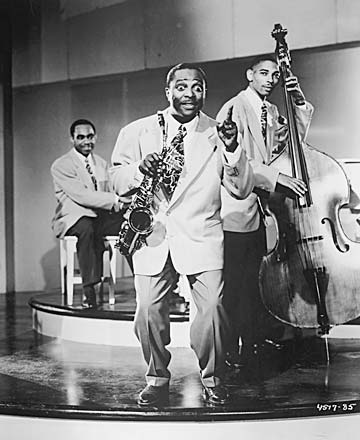
Louis
Jordan
1939
Leo Mintz founds a record store in Cleveland, the "Record
Rendezvous", specializing in black music. This was a revolutionary and
bold step in selling black music to white customers
1942
Louis Jordan launches "jump blues"
(rhythm and blues) with "Choo Choo Ch'Boogie "
1943
King Records
is founded in
1945
Les Paul
invents "echo delay", "multi-tracking" and many other
studio techniques
Johnny Otis
assembles a combo for "
Jules Bihari founds Modern Records in Los Angeles, specializing
in black music
1946
Muddy Waters
cuts the first records of
Carl Hogan
plays a powerful guitar riff on Louis Jordan's "Ain't
That Just Like a Woman"
Lew Chudd founds Imperial
Records in Los Angeles, specializing in black music
Specialty
Records is founded by Art Rupe in
1947
Billboard
writer Jerry Wexler invents the term "rhythm and blues" for electric
blues
Roy Brown
writes and cuts "Good Rockin' Tonight" in
Chess Records
is founded in
Ahmet Ertegun founds
Atlantic Records in New York to promote black music at the border between jazz,
rhythm and blues and pop
1948
John Lee
Hooker records Boogie "Chillen'" for Modern
Records, a a single, which topped the
R&B
charts in 1949.
Columbia
introduces the 12-inch 33-1/3 RPM long-playing vinyl record
Homer Dudley
invents the Vocoder (Voice Operated recorder)
Memphis'
radio station WDIA hires Nat Williams, the first black disc jockey
The magazine
Billboard introduces charts for "hillbilly" and "race"
records
1949
Fats Domino
cuts "The Fat Man," a new kind of boogie.
Hank
Williams' "Lovesick Blues" reaches the top of the country charts.
Scatman Crothers cuts "I
Want To Rock And Roll" (1949), with Wild Bill Moore on saxophone.
RCA Victor
introduces the 45 RPM vinyl record.
Todd Storz of the KOWH radio station starts the Top 40 radio
program.
The Billboard
chart for "race" records becomes the chart for "rhythm and
blues" records.
Aristocrat
changes its name to Chess.
Dewey
Phillips (white) deejays race music show 'Red Hot and Blue' in Memphis (Delta blues, Chicago blues, boogie).
1951
The white
Cleveland disc jockey Alan Freed decides to speculate on the success of LeoMintz's store and starts a radio program, Moondog Rock'n'Roll Party, that
broadcasts black music to an audience of white teenagers.
The first
rock and roll record, Ike Turner's Rocket 88, is released.
The first
juke-box that plays 45 RPM records is introduced
Howling Wolf
and Joe Turner popularize the "shouters"
Gunter Lee
Carr cuts the dance novelty "We're Gonna Rock
".
1952
Bill Haley Saddlemen become the Comets.
Bob Horn's
Bandstand TV program airs from Philadelphia every weekday afternoon.
The Cleveland
disc jockey Alan Freed (aka Moondog)
organizes the first rock and rollconcert, the Moondog Coronation Ball
Les Paul
invents the first solid-body electric guitar, named the 'Les Paul', for the
Gibson Guitar Company.
Sam Phillips
founds Sun Records and declares "If I could find a white man who sings withthe Negro feel, I'll make a million dollars".
Charles
Brown's "Hard Times" is the first hit by Jerry Leiber
and Mike Stoller to enter the charts.
Little
Richard's first records released.
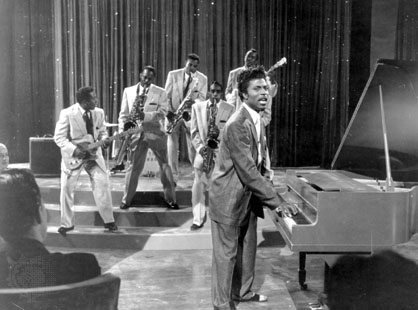
Little
Richard
1953
Bill Haley's
"Crazy Man Crazy" is the first rock and roll song to enter the
Billboard charts
The Orioles'
"Crying in the Chapel" is the first black hit to top the white pop
charts
Leo Fender
invents the Stratocaster guitar
Sam Phillips
records the first Elvis Presley record in his Sun studio of Memphis using tworecorders to produce an effect of "slapback" audio delay
The black
market constitutes 5.7% of the total American market for records
Vee-Jay Records is founded in Indiana, is owned by
James and Vivian Bracken, specializing in black music
Elvis Presley
makes his first (private) recordings
1954
Boom of Doo Wop
Bill Haley's
"Rock Around the Clock" is the first rock song used in a movie
soundtrack
The record
companies switch from 78 RPMs to 45 RPMs
Japanese
electronic company TTK (later Sony) introduces the world's first transistor
radio
Ray Charles
forms his band
In 1954, Big
Joe Turner recorded the original version of the 1950s hit, Shake, Rattle and
Roll.
Johnny Cash
forms the Tennessee Two with Luther Perkins and Marshall Grant
1955
Chuck Berry
cuts his first rock and roll records, the first ones to have the guitar as the maininstrument, and invents the descending pentatonic
double-stops (the essence of rock guitar)
Bo Diddley invents the "hambone" rhythm
The Chordettes and the Chantels are
the first girl-groups
Ray Charles
creates "soul" music with "I Got A Woman," a secular
adaptation of an oldgospel
Ace Records
is formed by Johnny Vincent in New Orleans, specializing in black music
The
Blackboard Jungle is released featuring Bill Haley and His Comets "(We're Gonna) Rock Around the
Clock"
RCA signs
Elvis Presley
The Everly Brothers make their first studio recordings
Alan Freed's Rock 'n' Roll Ball" draws huge, half-white
audience
Carl Perkins
records "Blue Suede Shoes"
Sales of 45
rpm records finally outsold 78s.
1956
Colonel Tom
Parker signed on as Elvis Presley’s manager
Heartbreak
Hotel starts Presley-mania
Presley's first
film, Love Me Tender
The rock 'n'
roll music of white rockers is called "rockabilly" (rock + hillbilly)
Screamin Jay Hawkins' "I Put A Spell On You"
introduces voodoo into Rock'n Roll
Wanda Jackson
is the "Queen of Rockabilly"
The popularity
of rock and roll causes the record industry to boom and allows independentlabels to flourish
In impromptu
recording session occurs at Sun Studios with the million dollar quartet
consisting of Jerry Lee Lewis, Carl
Perkins, Elvis Presley and Johnny Cash
Elektra
pioneers the "compilation" record, containing songs by different
musicians
Buddy Holly
had his first official recording session in 1956. It was held in Nashville at producer
Owen
Bradley’s, Barn Studio.
Brenda Lee
signs a recording contract at the age of 11, after five years of singing
professionally
Gene Vincent
made his first appearance on national TV by performing on The Perry Como Show
American
Bandstand first aired on nationwide TV
1957
Chuck Berry
releases "School Day" and "Rock and Roll Music"
Golden Age of
the teen-idols
Link Wray's
Rumble invents the "fuzz-tone" guitar sound
Buddy Holly
recorded, That’ll Be the Day, at a Norman Petty's New
Mexico studio.
Billboard
begins the Hot 100 singles chart
Buddy Holly
and Sam Cooke made their first
appearances on the same The Ed SullivanShow
1958
Elvis is
drafted into the Army
Carl Perkins
left Sun Records in 1958,becoming the first big rockabilly artist on the
Columbia label.
Golden age of
instrumental rock
Eddie Cochran
overdubs all instruments and vocals on "Summertime Blues" and
"C'mon Everybody "
Lowman Pauling invents guitar distortion and feedback on the Five Royales' "The Slummer"
RCA
introduces the first stereo long-playing records
Don Kirshner opens offices at the Brill Building
David
Seville's "The Witch Doctor" and the Tokens' "Tonite I Fell In Love" are the firstnovelty
hits
Bobby
Freeman's "Do You Wanna Dance" begins the
"dance craze"
Stax Records is founded in Memphis to promote black
music
Little Richard
quit rock and roll in 1958 to attend Bible college.
Dion and The Belmonts and
Laurie Records both had their first hit when the band’s, "I Wonder
Why," made the Top 40
Jerry Lee
Lewis had 34 of his 37 concert dates in the U.K. cancelled in 1958 when it wasdiscovered that his new bride with him was also his 13
year old cousin.
Buddy Holly
makes his final studio recordings " It Doesn’t Matter Any More,"
"Moondreams," " Raining
In My
Heart" and "True Love Ways"
The Dick
Clark Show TV Show began
1959
Rick Hall
founds the FAME studios in Muscle Shoals, Alabama
The Drifters'
"There Goes My Baby" introduces Latin rhythm to pop music Berry Gordy founds Tamla-Motown in
Detroit to release pop-oriented soul records
600 million
records are sold in the USA
Buddy Holly
dies at 22 in a plane crash
Since 1955,
the US market share of the four "majors" has dropped from 78% to
44%,while the market share of independent record companies increased from 22%
to 56%
Since 1955,
the US market has increased from 213 million dollars to 603 million, and the
market share of rock and roll has increased from 15.7% to 42.7%
1960
Elvis appears
on the Ed Sullivan Show following his release from the Army.
Twist is the
biggest dance-craze in the year of the dance-crazes
Larry Parnes, Britain's most famous impresario, arranges a show
for the Silver Beetles in Liverpool
Sam Cooke
signed with RCA Records in 1960, bringing his hits on Keen Records with him
The Shirelles' "Will You Love Me Tomorrow" coins a
form of romantic multi-part vocal harmonies
The British
producer Joe Meek uses the recording studio like an instrument for "I Hear
a New World "
Eddie Cochran
dies at 22
Ray Charles
has his first Number 1 hit "Georgia On My Mind "
1961
Dick Dale
uses the term "surfing" to describe his instrumental rock and roll Stax begins to produce soul records in Memphis
The
Peppermint Lounge opens in New York
Roy Orbison has his first number #1 hit, "Running
Scared"
Phil Spector and partner Lester Sill released the "Oh Yeah Maybe
Baby" on their new label Philles
1962
The Supremes
first recordings are released.
James Brown
record his famous Live At the Apollo album
1963
Surf music
rules the airwaves
Little Stevie Wonder recorded his first Number 1 hit,
"Fingertips – Pt. 2,"
1965
Alan Freed,
the man who gave rock ‘n’ roll its name,
dies at the early age of 43
_____________________
AARDVARK
For more info on Theosophy
Try these
Dave’s
Streetwise Theosophy Boards
If you run a Theosophy Group,
Please feel free to use any of the
material on this Website
The
Cardiff Theosophical Society Website
The
National Wales Theosophy Website
This
is for everybody not just people in Wales
Theosophy Wales
has a new structure as it separates into
independent groups that run
their own show
Theosophy Cardiff’s Instant Guide
High
Drama & Worldwide Confusion
as Theosophy
Cardiff Separates from the
Welsh
Regional Association (formed 1993)
One Liners & Quick Explanations
The Most Basic Theosophy Website in the Universe
If you run a
Theosophy Group you can use
this as an
introductory handout
The
South of Heaven Guide to
Theosophy and Devachan
The main criteria
for the inclusion of
links on this site is
that they have some
relationship (however
tenuous) to Theosophy
and are lightweight,
amusing or entertaining.
Topics include
Quantum Theory and Socks,
Dick Dastardly and Legendary Blues Singers.
Lentil burgers, a
thousand press ups before breakfast and
the daily 25 mile
run may put it off for a while but death
seems to get most of
us in the end. We are pleased to
present for your
consideration, a definitive work on the
subject by a Student of
Katherine Tingley entitled
General pages
about Wales, Welsh History
and The History of
Theosophy in Wales
The Spiritual Home of Urban Theosophy
The Earth Base for Evolutionary Theosophy
Tekels Park,
Camberley, Surrey, England GU15 -2LF
Article
describing Tekels Park and its much
cherished wildlife by
Theosophist and long
term Tekels Park
Resident Madeleine Leslie Smith
Classic Introductory Theosophy Text
A Text Book of Theosophy By C
What Theosophy Is From the Absolute to Man
The Formation of a Solar System The Evolution of Life
The Constitution of Man After Death Reincarnation
The Purpose of Life The Planetary Chains
The Result of Theosophical Study
An Outstanding
Introduction to Theosophy
By a student of
Katherine Tingley
Elementary Theosophy Who is the Man? Body and Soul
Body, Soul and Spirit Reincarnation Karma
Preface
Theosophy and the Masters General Principles
The Earth Chain Body and Astral Body Kama – Desire
Manas Of
Reincarnation Reincarnation Continued
Karma Kama Loka
Devachan
Cycles
Arguments Supporting Reincarnation
Differentiation Of Species Missing Links
Psychic Laws, Forces, and Phenomena
Psychic Phenomena and Spiritualism
Quick Explanations with Links to More
Detailed Info
What is Theosophy ? Theosophy Defined (More Detail)
Three Fundamental Propositions Key Concepts of Theosophy
Cosmogenesis
Anthropogenesis
Root Races
Karma
Ascended Masters After Death States
Reincarnation
The Seven Principles of Man Helena Petrovna Blavatsky
Colonel Henry Steel Olcott William Quan Judge
The Start of the Theosophical Society Theosophical Society Presidents
History of the Theosophical Society Glossaries of Theosophical Terms
History of the Theosophical Society in Wales
The Three Objectives of the Theosophical Society
Explanation of the Theosophical Society Emblem
Karma Fundamental Principles Laws: Natural and Man-Made The Law of Laws
The Eternal Now
Succession
Causation The Laws of Nature A Lesson of The Law
Karma Does Not Crush Apply This Law
Man in The Three Worlds Understand The Truth
Man and His Surroundings The Three Fates The Pair of Triplets Thought, The Builder
Practical Meditation Will and Desire
The Mastery of Desire Two Other Points
The Third Thread Perfect Justice
Our Environment
Our Kith and Kin Our Nation
The Light for a Good Man Knowledge of Law The Opposing Schools
The More Modern View Self-Examination Out of the Past
Old Friendships
We Grow By Giving Collective Karma Family Karma
National Karma
India’s Karma
National Disasters
Try
these if you are looking for a
local Theosophy
Group or Centre
UK Listing of Theosophical Groups
Within the British Isles, the
Adyar Theosophical Society has Groups in;
Bangor*Basingstoke*Billericay*Birmingham*Blackburn*Bolton*Bournemouth
Bradford*Bristol*Camberley*Cardiff*Chester*Conwy*Coventry*Dundee*Edinburgh
Folkstone*Glasgow*Grimsby*Inverness*Isle
of Man*Lancaster*Leeds*Leicester
Letchworth*London*Manchester*Merseyside*Middlesborough*Newcastle upon Tyne
North
Devon*Northampton*Northern Ireland*Norwich*Nottingham
Perth*Republic of Ireland*Sidmouth*Southport*Sussex*Swansea*Torbay
Tunbridge Wells*Wallasey*Warrington*Wembley*Winchester*Worthing
Worldwide Directory of Theosophical Links
______________________
& of course
you don’t need to live in Wales
to take advantage
of this guide
Your Own
Theosophy Group Starts Here
A Guide to
starting your own
Theosophy Group
These are
suggestions and pointers for forming
your own independent
Theosophy Group and
not instructions on how
to form a branch of a
larger Theosophical Organisation.
The subject of
affiliation to a larger body is
covered but as
affiliation may mean compromise
and nobody owns
Theosophy anyway, we leave
that decision entirely up to you
___________________
Blog Links
http://london-underground.blogspot.com
This site is a directory of weblogs
written by
people who live or work
in London, organised
by the rather
iconic London Tube map (and also
the central London
suburban rail network,
docklands light railway
and Croydon tramlink)
http://londonbloggers.iamcal.com/
Theosophy Aardvark is represented
British Blog Directory
Blog
Catalogue Directory
Bloggernity.com
RSS - Blog Directories
Blog Flux Blog Directory
Best of the Web Blog Directory

General pages
about Wales, Welsh History
and The History of
Theosophy in Wales
Wales is a
Principality within the United Kingdom and
has an eastern border
with England.
The land area is
just over 8,000 square miles.
Snowdon in North Wales is
the highest mountain at 3,650 feet.
The coastline is
almost 750 miles long.
The population of Wales as at the 2001 census is 2,946,200.
And as “I’m Sorry I Haven’t a
Clue” is
very popular with Theosophists